The Anatomy of The AbdomenAlthough you almost certainly don't have to know where your external oblique muscles are or what the fascia of Scarpa is to have an abdominoplasty, I thought I'd offer a description of the anatomy of your abdomen so that you'll know what these muscles and other parts do so you are better educated before your tummy tuck. You probably don't need to know this information, but if you want it, you can find it here. We are going to discuss the skin, fat layers, and muscles of the abdomen, but we wont go into the abdominal organs such as the intestines. They are not (or certainly are usually not) involved in a tummy tuck surgery. Skin Let's start with the skin. It is the part of your abdomen's anatomy you can see. Often, it is the most depressing aspect, if it has lost its ability to spring back after being stretched out. Skin is constantly replenishing itself. The top layer of skin is called the epidermis. New cells are added at the bottom of the epidermis and are slowly pushed up to the top as new cells are formed below them. By the time cells get to the top, they are dead and fall off. In younger people, skin replaces itself in this process about every 15-18 days. For people in their mid-30s, the process slows down to as long as every 28 days. Below the epidermis is the dermis, which contains oil glands, nerves, capillaries, and sweat glands. The dermis also contains collagen and elastin, which give skin its springiness when you are young. Without collagen and elastin, your skin would feel like crepe paper and would have no give to it. We tend to lose elastin and collagen as we age, which is why skin gets thinner and looser as we get older. Healthy younger skin is able to stretch out and then spring back to its original shape. We loose some of this elasticity as we age. If your skin is stretched out, hangs loosely, and has not bounced back within several months after a weight loss or pregnancy, it is not going to bounce back. Loose, excess skin is called redundant skin, but not everyone has it if his or her abdomen is saggy. If you have a significant fat layer on your abdomen or if the muscles and fascia of the abdomen have loosened, you may think you have excess skin, but you don't. If you don't have excess fat on your abdomen and your muscles are relatively tight, but you still have excess skin, a simple skin excision may be your best bet rather than an abdominoplasty. But I may be getting ahead of myself. Fat Many of us hate body fat especially stomach or abdominal fat. I know I do. But we need body fat. It is essential to health. You would look gaunt and harsh without it and you would probably be perpetually cold. However, many of us have more body fat than we'd like. Many women (including me) tend to hold excess fat in our thighs, buttocks, hips, and stomach (abdominal fat). Men tend to hold it in their abdomen and around the waist area. Some men and women have excess visceral fat that can create a potbelly, even after liposuction or a tummy tuck. Then to top that off, as I am sure you have noticed, our metabolism slows as we age. What is up with that??!! We work out like crazy and diet until we are skinny everywhere except the area where we want to lose the fat. We buy girdles, fat creams, sessions of Endermologie, spend our lunch hour on stair climbers, and still, the abdominal fat is stuck to us like glue. Well, hooray for liposuction and manual fat removal! Fat removal is usually a routine addition to tummy tuck surgery no matter how loose your skin or muscles are. Fat is also called adipose tissue and an individual fat cell is an adipocyte. There are primarily two types of fat in humans, brown fat and white fat. But since brown fat is usually only found in newborn babies, you just have to worry about the white fat. Even abdominal fat is useful and the body needs it. Without a fat layer, you would freeze to death, have no energy stores, and have to eat constantly. Your body would not function properly and, every time your body exerted more energy than you took in from food that day, you'd burn muscle. Hey, the fat on your butt even makes it a bit more comfortable to sit. But, we all have a little more than we'd like or need. There are three layers of abdominal fat. There is a relatively dense, superficial layer of fatty tissue that is just under the skin. This is not commonly removed, although people with loose skin may benefit from superficial liposuction. The superficial fat layer is denser and is tightly packed with nerves, and blood vessels. There is the extra-abdominal fat layer, which is below the skin but not within the abdominal cavity (also called the peritoneal cavity). This is the layer that is commonly removed in liposuction Lastly, there is the visceral layer, which is within the abdominal cavity and which, in my unprofessional opinion, should not be touched. The visceral layer is the deepest area of fat and it is sometimes called intra-abdominal fat. It surrounds and covers the intestines and other organs within the abdomen. This layer of fat cushions and protects the abdominal organs. Visceral fat can be quite prominent in those who are obese or have apple-shaped body types. Proper diet and exercise is essential in regulating the amount of visceral fat. However, hormonal disorders or fluctuations may cause your body to develop more visceral fat, as can some medications One class of medications that can lead to excessive visceral fat is the protease inhibitors, a class of antiviral drugs used to treat HIV. People treated with these drugs often develop a potbelly and a hump of fat over the top of their back and shoulders. While liposuction is an option to remove the "buffalo hump," it cannot safely remove the "protease paunch." Even if you have a lot of visceral fat, it is very dangerous to try to remove it with liposuction because of the risk of puncturing or damaging the organs within the abdomen. Most liposuction procedures target the extra-abdominal layer of fat and not the visceral fat. The percentage of fat in an individual's body and its placement depends on hormones such as insulin, testosterone, and estrogen. The one thing to remember about fat is that, once puberty is over, what fat you have is what fat you have forever. Your fat cells only multiply if you reach 200% of what your body weight should be, which, luckily most of us don't ever do. However, fat cells can expand enormously. Each and every one of them can get bigger as your body stores more fat in them. Insulin is a huge culprit in fat storage, which means anything that can cause your insulin to spike can lead to more fat storage. Candy and sugar aren't the only bad guys. Bread, potatoes, carrots, corn—anything which has a high glycemic index—can increase fat storage. Excess intake of these items can cause excess fat. And America lives off of boxed and processed foods and lots of carbohydrates. Sugar, sugar everywhere equals a lot of fat, ya think?? Not only does it increase your waistline is disrupts your hormones as well. (Sorry, I've gone off on a tangent.) Fascia Fascia is a thin membrane that covers almost all the muscles and many organs. If you have ever cooked a roast, you may have seen a silvery membrane on parts of the uncooked meat. That is fascia. Fascia acts as a sheathe and helps protects what it is covering and pretty much keeps us in a compact form as opposed to the shapeless jellyfish we would resemble if we didn't have it. Okay, it would not be that bad, but fascia is very important! The important fascia membranes in the abdomen are the superficial fascia and the deep fascia. When the superficial fascia becomes stretched out, it can give your abdomen a distended look even if your muscles are toned. The deep fascia, which lines the inside wall of the abdominal muscles and separates them from the abdominal organs, can also become stretched out. Normally in an abdominoplasty, the surgery tightens the muscles, superficial fascia, and skin only, not the deep fascia. The most important (at least in terms of a tummy tuck) part of the fascia of the abdomen is the linea alba (Latin for "white line," since it is a band of fascia that looks like a vertical white line). This is the centerline of your abdomen and runs vertically between your rectus abdominus muscles. This should be a narrow partition between the two muscles, but it can become stretched and widened. Abdominal Muscles There are certainly more muscles in the torso than just the external obliques, the internal obliques, and the rectus abdominus muscles, but for a tummy tuck, they are the ones that matter most. These three sets of muscles are responsible for the shape of your abdomen and are the chief muscles that become stretched with age and pregnancy. The external oblique muscles (sometimes called by their Latin name, the obliquus externis) run on each side diagonally down and in from the lower eight ribs at your sides to the linea alba and the part of the pubic bone called the pubic crest. The internal oblique muscles (sometimes called the obliquus internis) run on each side diagonally down and out from the lower three or four ribs to the iliac crest at the side of the pubic bone. The external and internal obliques run at an angle to each other. 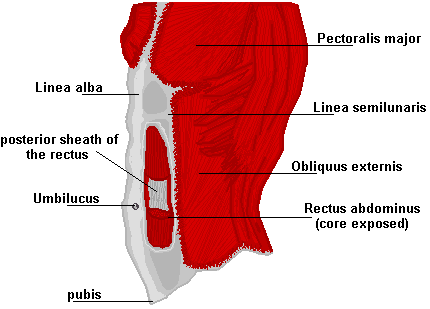 Exposed core of the Rectus abdominis The rectus muscles run on each side of the linea alba vertically from the pubic crest to the bottom of your breast bone. The rectus muscles form your six-pack, if you work out enough and don't have any fat covering them. Although it looks like six separate muscles, it is actually just two that look like they are divided because of bands of connective tissue. 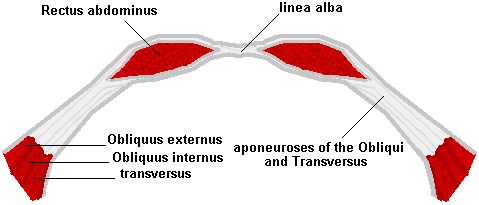 Cross-section of the sheath of the Rectus abdominus, linea alba, transversus and Obliquus abdominus (imagine yourself looking down at a cross-section of your tummy (without the organs, of course) The rectus abdominus muscles and the linea alba and other fascia around them and connecting them can become loose, like an old rubber band stretched once too often. They take the brunt of the stretching that accompanies pregnancy and weight gain. The rectus muscles, which should be right next to each other, become separated and this separation is called diastasis. The main event in a full abdominoplasty with muscle repair is the folding over (called plication) and suturing of that stretched-out tissue to restore a slimmer, flat stomach. 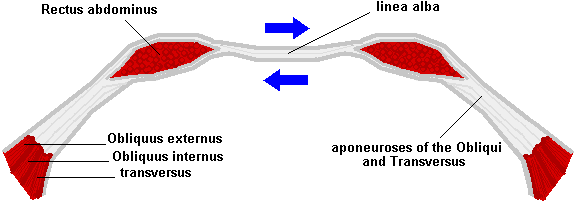 Rectus abdominus, linea alba diastasis The abdominal muscles and skin can become lax due to pregnancy and weight gain, but even if you have never been pregnant or overweight, this area can become lax with age. In addition to lax muscles and skin, we might have thin white lines and deep purplish fissures in the skin—stretch marks! I have several stretch marks due to weight gain from birth control pills. Well that's the anatomy of the abdomen in a nutshell, at least that's all we need to know to understand what the surgeon is going to do during an abdominoplasty. If you'd like more information, you can ask your surgeon what he or she is specifically going to do in your case. |
